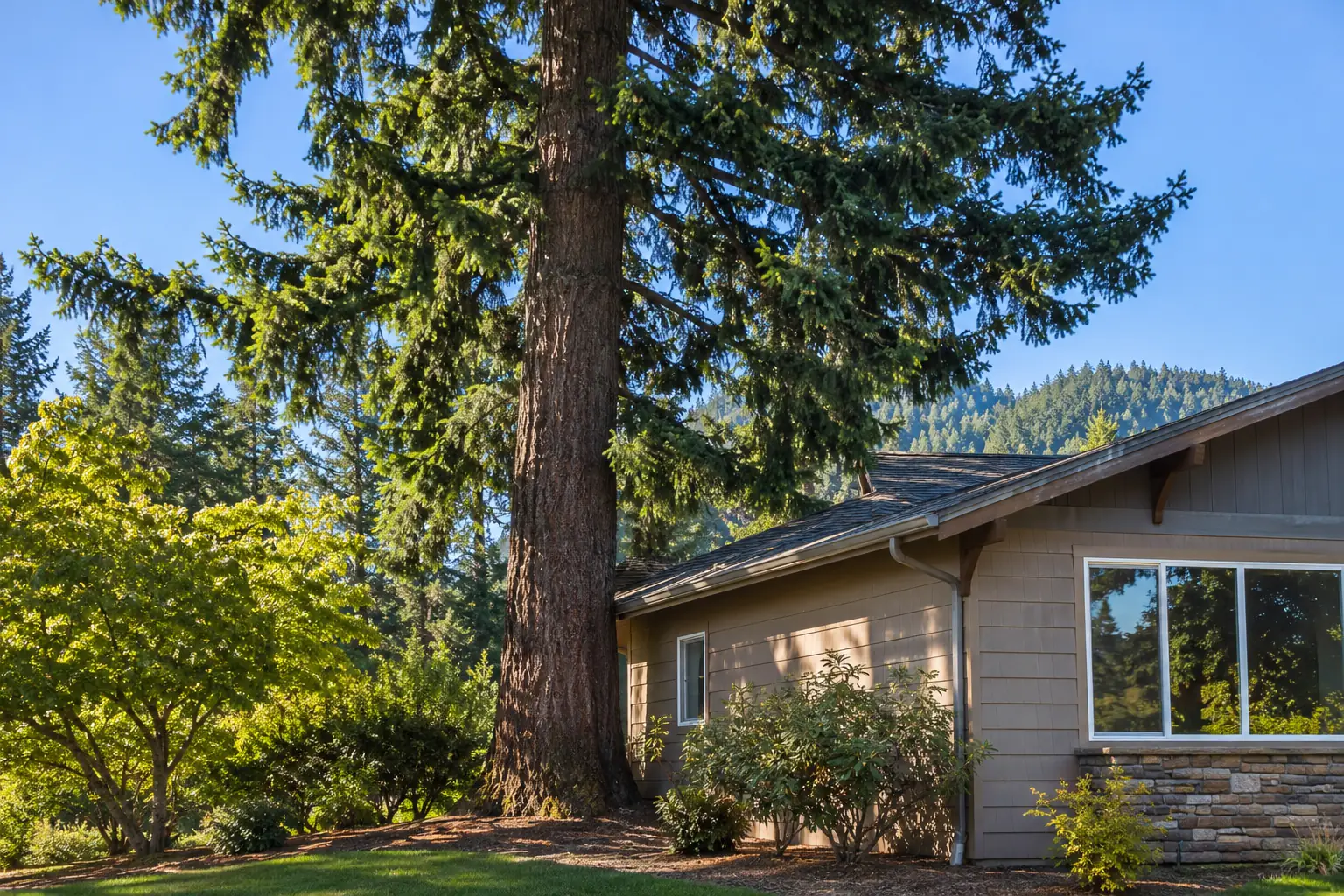
Removing a large tree in Grants Pass, such as a tall Douglas-fir, ponderosa pine or old oak near a house, is a job for an experienced tree company with the right gear. Call (541) 507-9679 to reach a single tree service near Grants Pass, independent of this site, that holds an active Oregon CCB license. Have it explain its plan for lowering the tree and what gear that takes. Estimates are the company's to price, so on a big tree ask up front whether the visit is free.
What makes a tree a large removal job
A tree counts as a large removal when its height, spread or weight means it cannot simply be cut at the base and dropped. Size alone does not decide it. What the tree could hit on the way down matters just as much.
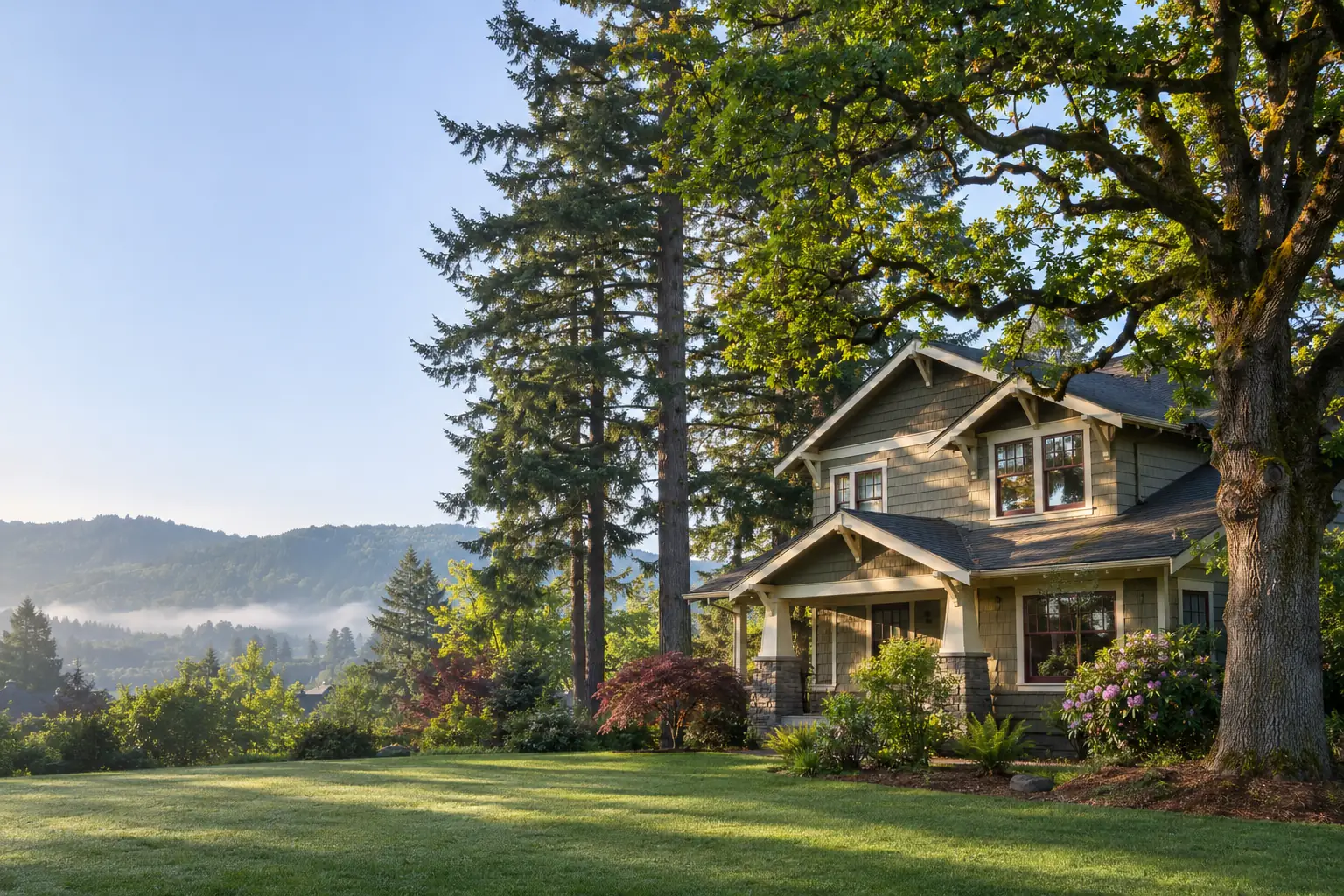
A 90-foot pine in an open field may be simpler than a 50-foot oak spreading over a roof, a fence and a neighbor's garage. Large jobs usually involve climbing or a lift, cutting the tree in sections from the top down and lowering heavy pieces on ropes. Some need a crane. Cost guides price trees by height for this reason. A tree over 60 feet sits in the higher bands in every guide listed in the Grants Pass tree removal cost guide.
Big trees common around Grants Pass
The large trees people most often want removed around Grants Pass are native conifers and oaks that grew up before the houses did. Each brings its own issues.
Douglas-fir is the tree most often in trouble here. Oregon State University Extension's Trees on the Edge, published September 2023, reports that Douglas-fir mortality in southwest Oregon has stayed high since 2015. It describes heat and drought, plus the flatheaded fir borer, as the main causes on low, dry sites near the Rogue and Applegate valleys. Ponderosa pine is native to southern Oregon, and the city even lists it on its approved street tree examples. Pines can be lost to Ips beetles when stressed. Oregon white oak and incense cedar are both hosts for true mistletoe, according to OSU Extension's mistletoe publication. The oak and pine problems guide covers these in detail.
How a large tree comes down
Most large trees near homes are taken down in pieces rather than felled whole. The method depends on the space around the tree and how sound the wood is.
Felling. Where there is open ground longer than the tree is tall, a sound tree can be notched and dropped in one direction. This is usually the cheapest method.
Sectional removal. A climber or a lift works from the top down, cutting limbs first and then the trunk in short lengths. Pieces are dropped into a clear area or lowered on ropes past the roof, fence or garden.
Crane removal. A crane holds each section as it is cut and swings it over the house to the street or driveway. Cranes cost more per hour but can make a dangerous tree faster and safer to remove, especially a dead one that a climber should not trust.
A dead tree changes the plan. Dead wood is brittle and can break in ways a climber cannot predict, so companies often use a lift or crane on dead firs and pines. Ask the company which method it plans to use and why.
Access, wires and the neighbors
Access is often what drives the time and cost of a large removal. Trucks, chippers and cranes need a firm, wide path, and the crew needs somewhere to drop or stack wood.
Before the estimate visit, think about gates, septic fields, soft lawns and low branches over the driveway. If the tree hangs over a neighbor's yard, let them know about the work in advance. If any wire runs through or near the crown, the utility has to be involved. Pacific Power tells customers to never prune or remove trees near power lines. It says it can arrange a free temporary service disconnect when work near your service line requires it. Request one at 1-888-221-7070 well before the job date. A limb already resting on a wire is not planned work: keep 35 feet off, call 911, then Pacific Power's outage number, 1-877-508-5088.
Fire season and big saw jobs
Fire season can affect when a big removal is scheduled. Large jobs often mean hours of saw work and a chipper, both of which create sparks and heat.
The Oregon Department of Forestry's 2026 regulated closure for southwest Oregon, effective May 15, 2026, banned power saws on and near protected forestland during extreme fire danger. It confined them to times outside 1 p.m. to 8 p.m. on moderate-danger days, and outside 10 a.m. to 8 p.m. on high-danger days, with a one-hour fire watch after use. Other spark-emitting engines had similar limits. If your property falls in that area, ask the company how it schedules large jobs during fire season. Booking a big removal for late fall through early spring avoids most of these limits. The Josephine County wildfire tree work guide explains the fire danger levels.
Large trees that need a permit
A large tree needs a city permit in Grants Pass when it stands on public or semi-public land or has special status. The city's tree permit covers public and semi-public land, so a tree wholly on private land is generally outside it.
If the tree is in the planting strip or elsewhere in the public right-of-way, the city's tree permit page says a permit is required and the work must be done by a city-prequalified contractor certified by the International Society of Arboriculture. The permit also needs a sketch and a traffic control plan, since big trees by the street often mean closing a lane. If the tree is a designated Heritage Tree, the city code requires a removal permit even on private land. The Grants Pass tree rules guide covers the details. Ask whether the company you reach is on the city's prequalified list if the tree is by the street.
What large tree removal can cost
Large trees sit at the top of every published price range, and the final number depends heavily on access and method. National guides give a starting point.
This Old House's cost guide, updated March 5, 2026, lists $800 to $1,500 for trees 60 to 80 feet and $1,000 to $2,000 for trees over 80 feet. LawnLove's guide, updated October 5, 2026, lists $870 to $1,160 for 60 to 80 feet and $1,160 to $2,000 for trees over 80 feet. A crane, a dead tree or a tree over a house can push a price above those ranges. For rural acreage with many dead firs, OSU's Trees on the Edge says removal or fuel treatment can run more than $5,000 per acre in some cases. These are not Grants Pass quotes. The written estimate from the company that sees your tree is what counts.
What to ask before you hire
A few questions at the estimate visit protect you on a big job. Ask them all, and get the answers in writing.
- What is the CCB number? Check it on the Oregon CCB license search.
- What method will you use, and will you need a crane or a lift?
- Is cleanup included, and what happens to the logs and brush?
- Is stump grinding included, or priced separately?
- Who handles any permit or utility disconnect?
If you also want the stump gone, the stump grinding page explains the options.
Large trees on rural lots in Josephine County
Large removals are common outside the city, where lots are bigger and the trees are often older and taller. Rural jobs may involve long hauls for equipment and more wood to deal with.
Calls come in from Wilderville, Williams, Provolt, Murphy and the other towns around Grants Pass. On acreage, many owners keep the logs as firewood or have them cut to length and stacked. Tell the company what you want done with the wood when you first call. For how the referral service works, start at the Grants Pass tree removal home page.
Frequently asked questions
How do I know if my tree needs a crane?
The company decides that at the estimate visit. A crane is more likely when the tree is dead, leans over a house, or has no clear drop zone and no safe place for a climber to tie in. Cranes cost more per hour but can shorten a risky job.
Can a large tree be removed without damaging my lawn?
Some lawn damage is common on large jobs, since trucks and heavy pieces are involved. Ask the company how it will protect the lawn, such as with mats or plywood, and whether repair is included. Soft winter ground is easier to rut.
Do I need a permit to remove a big pine in my Grants Pass backyard?
A tree wholly on private land is generally outside the city's tree permit, which covers public and semi-public land. Heritage Trees and right-of-way trees are the main exceptions. If you are unsure where your property line is, call the city at 541-450-6000.
Who keeps the wood from a large tree?
That is settled between you and the company. Some haul everything, and some leave logs cut to length, which may change the price. Say what you want before the estimate is written so the price reflects it.
Will my homeowners insurance pay to remove a large healthy tree?
Policies usually do not pay to remove a healthy standing tree just because the owner wants it gone. Coverage is more likely when a covered event damages an insured structure. Check with your insurer before you plan around it.